Average Reviews:

(More customer reviews)I have given this a 5-star rating in spite of a few flaws mostly to counteract the frankly irrational and severely negatively biased earlier reviews, the nature of which strongly suggest to me more of a witch hunt against the authors then an honest review.
Little background on me: I am primarily an armourer, specializing in Vendel Period helmets but I also forge my own swords and daggers, make riveted maille, do a lot of cutlering, and so forth. To aid in these endeavours I have accumulated a VERY large library on the subject - something on the order of 200-300 or so books, archaeological journals and articles, and the like, including a lot of rare and foreign language books. Not included in this are many other texts on blacksmithing, woodworking, jewelry making and so forth to teach the basic skills needed. So even though furniture is not my specialty, I do have a very thorough understanding of doing reproduction work in general and scholarship in particular. Keep this in mind as we proceed.
Let us first discuss the legitimate flaws of this work, followed by exposing the absurd review points, and then close with the strengths of this very useful book.
The only significant flaw in this book is the lack of good documentation. While it is obvious that the authors had *some* basis for the assertions made, even I found many of the historical notes dubious. Not that I am able to refute them (and it should also be pointed out that none of the negative reviewers seem capable of citing sources, either) but it would have made for a much better work had statements such as these been carefully documented. This is a very serious problem with the book, and a legitimate complaint.
With that out of the way, the rest of the points raised range from "True, but so what?" to bizarre and idiotic.
1. "Not the Greatest and Not the Worst" states one reviewer in his title. But this is incorrect - this book and its successor are the ONLY books of this kind to be found anywhere. No other books in existence on this subject provide detailed plans and instructions.
1. "Not very useful to the beginning woodworker" whines one anonymous critic. While technically true, nowhere does it state in either this book or the companion volume that they were intended for beginning woodworkers (I know - I actually *read* the books...). The goal was to give basic step by step how to instructions, which these books deliver. They do assume, however, that the reader knows which end of a chisel is which. If you don't, you might want to read a primer on woodworking (see my review on the companion volume for suggestions) before tackling the projects contained herein.
2. "...if you are looking for the exact plans measured off the real thing then save yourself some time." Actually, they have "measured off the real thing", but they do make extrapolations for damage and wear that the original items have sustained over the last several centuries, which they do clearly state up front. To me, this is more helpful then taking "exact" measurements from damaged and worn items. We're trying to recreate the original form and appearance of this furniture, not they're current dilapidated and rotted state!
3. "...he dosen't [sic] appear to be a seasoned woodworker talking about making medieval furniture, but someone into medieval times writing about the furniture;..." Perhaps this is so, but I'd rather have an "unseasoned" enthusiast who actually gives you some practical instructions on getting from a pile of raw materials to a finished product rather than a "seasoned" disinterested lecturer who gets you nowhere. It would be best, naturally, to have both (i.e. a "seasoned enthusiast"), but these books are valuable nonetheless in spite of this real but ultimately quite trivial flaw.
4. "Anybody serious about medieval furniture should not consider this authoritative." True, but irrelevant. Look, you can stare at the lovely pictures in Chinnery's book on British Oak Furniture for decades and still not have a clue how they were put together. Again, for the weak minded, these books are simply intended to give solid start to finish instructions on the actual construction of Mediaeval furniture; if you need more in order to complete a true, hand crafted, 100% authentic masterpiece you will need to supplement with other works on the subject (see my review of the companion volume for some suggestions).
5. "...8 of the 19 projects are considered mideval [sic] on a technicality - beging [sic] made 50 or so years before the time frame ended." Setting aside this hatchet reviewer's laughable grasp of the English language (mideval?!? Good God!!!), the comment itself is simply moronic. It ignores the fact that precious little original material even survives from the period. And it's not as if other books are any better - Chinnery's book has less than 5% of its material from the 15th century or earlier, a bit of stuff from the 16th century, and the remaining 85%+ dates from the 17th century and later! Even more to the point is Tracy's "English Medieval Furniture", which, in spite of being explicitly about Mediaeval furniture (says so in the title!), has somewhere between 2/3 and 3/4 of the material presented within its pages from the 16th century, which is technically Renaissance. And these are considered highly authoritative (not to mention incredibly expensive) works on this subject!!! Don't get me wrong, they are very useful, but even they do not come close to achieving the ridiculous and ignorant standards set by this obviously not very knowledgeable reviewer. And 19 people actually found this cretin's comments *useful*? Oy Vey! I knew that education standards had dropped precipitously in this country but I had no idea it was this bad... Seriously, disregard this "observation" - it is way off base and just plain flat out WRONG.
The Strengths:
Quite simply, full plans, material lists, and reasonably clear instructions from start to finish on recreating a wide range of Mediaeval furniture, ranging from chests, to cupboards, beds, candlestands, chairs, and so forth. By following them you will end up with a piece that certainly *looks* accurate, and is in fact about 80-90% correct, more or less (depending on the specific piece). Even if you are trying to satisfy an "authenticity nazi" these books can still provide a good starting point, though, naturally, you will have to supplement with other more in-depth research to get in that last 10-20% of accuracy.
These books are an OUTSTANDING value at the price they are being offered at. They provide a decent starting point for someone who understands basic woodworking and wants to try their hand at making truly unique furniture items. Certainly, there are online resources that should be sought out as well, for additional plans not found here and fresh insights, but these books stand on their own.
What frakkin more do you people want, anyway? Talk about *picky*! I'd have given my eye teeth to have an equivalent reference available when I started out making ancient arms and armour!
Perhaps if some of these negative reviewers would spend less time whining about Diehl's frankly positive contribution to this very much neglected subject and come up with their own book that not only provides plans and instructions but corrects all of the flaws they perceive I would be more impressed. I am not holding my breath waiting...
P.S. No, I do not know the authors of this book, nor do they know me even from a hole in the ground. But I do know useful work when I see it, and equally know personally biased and ignorant reviews when I have the misfortune of reading them, and could not let these go unchallenged.
Click Here to see more reviews about: Constructing Medieval Furniture: Plans and Instructions With Historical Notes (Master Craftsmen)
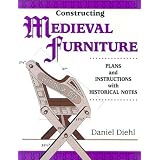
This book offers you designs for building sixteen reproductions of furnishings from the Middle Ages. The detailed plans are based on careful study and measurement of rare originals, and the complete, step-by-step instructions, materials lists, and notes on woodworking, metalworking, and finishes provide you with the means of recreating these pieces accurately in your own home shop.
 Get 25% OFF

0 comments:
Post a Comment