Average Reviews:

(More customer reviews)This book is a facsimile of AMERICAN COUNTRY HOUSES OF TODAY by architect Lewis A. Coffin which was originally published in 1934. The introduction is only two pages, but it discusses the past, present, and future of country houses (that is, houses out of a strictly urban environment), a discussion with observations, questions, and fears that are still valid today. The author asks why we cannot make houses that are better planned, more liveable and more beautiful than those built by architects of the past. Coffin asks why the basic principles of simplicity, of proportion, of balance, and of well designed detail cannot be adopted along with new materials and technology. Why indeed? He blames the lazy or incompetent architect that finds it easier not to have to struggle towards the basic principles of good design for unsuccessful houses that mar the landscape throughout the country, still an issue today.
This book consists of two parts. The first part begins with the design of a modern house with a classical precedent, but the rest are built designs as evident by the photo of the exterior. In some instances, interior views are also shown. And floor plans, both floors as applicable, are shown for each of the architect-designed houses. About 60 architectural firms are represented including Dwight James Baum, Delano & Aldrich, Frank J. Forster, Howe & Lescaze, Mellor & Meigs, the Office of John Russell Pope, and Royal Barry Wills. Most houses fall in the category of Colonial -- Cape Cod, Georgian, Monterrey, California Ranch, Creole -- but there are also English Cottage, French Country, Regency, and even a couple in the International Style. Although a few are quite modest, most are moderately substantial. Judging from the mature plantings, most of these houses were designed and built before the hardships of the Great Depression had set in.
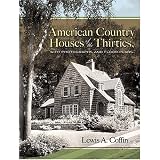
The second part consists of some of the more notable submittals to the Small House Competitions of 1932 and 1933. Held by an organization called The Better Homes of America to promote quality in small houses, there were restrictions in cubic footage and designs had to be executed by architects within the previous 5 years. Floor plans along with at least one photo, like in the first part, are presented for 21 houses, includig the one pictured on the cover of this Dover edition. This reviewer is particularly enamored of a modest board-and-batten cottage with a wood shake roof owned by Dr. Seeley G. Mudd of Santa Barbara County, California; the site is only about 35 feet wide, but it is 782 feet long and extends across a beach to the edge of the Pacific Ocean.
Instead of finding a horrible design in any one of the house plan magazines currently found in stores across the country, persons wanting to find ideas for the basis of a new home would do well to include one book like this as part of their research. At the very least, a design from an archival source might be used as a starting point for those wanting a compact and economic plan that is also attractive. This is an interesting book for all who enjoy the history of American Architecture and traditional residential design.
Click Here to see more reviews about: American Country Houses of the Thirties: With Photographs and Floor Plans (Dover Books on Architecture)
Featuring blueprints, sketches, plus exterior and interior photographs, here are the finest examples of 1930s country homes from 70 different architectural firms. Originally designed during a creative peak of American architecture, the houses embrace a wide variety of styles, from simple cottages to large estates, rough hewn to elegant.
 Get 20% OFF

0 comments:
Post a Comment